Each agency in the Department of Energy, Environment and Climate Action (DEECA) charges a range of fees and penalties. These may apply to areas such as wildlife permits, water licensing, and agricultural services. These charges help support the regulation and delivery of DEECA’s environmental and land management responsibilities.
Fees and penalties
Many DEECA fees are indexed each year under the Monetary Units Act 2004 and are expressed in fee units.
Penalties are calculated using penalty units. For example, fines for wildlife offences or non-compliance with water licensing conditions may be set in penalty units under the relevant legislation. The value of a fee or penalty unit is determined annually by the Treasurer. The Department of Treasury and Finance (DTF) publishes the current and historical unit values.
For the most up-to-date information, visit the DTF Indexation of Fees and Penalties page.
Fees, charges and fines
Information about the department's services that require a fee and how to pay a fine, or request a review of a fine, can be found under each of the department's service areas below. Information on the department's top tasks/purchases (recreational fishing licence, game licence, National Livestock Identification System tags and miner's right) are also included.
Automatic indexation of fees and penalties
The following documents list the automatically indexed fees and fines which are the responsibility of the department and which contribute to the Victorian Government's consolidated revenue.
Agriculture infringement notices
This page has information to assist people who have received an infringement notice from an Authorised Officer of the Agriculture regulator.
Making online payments
- To pay an invoice from the department - use the online payments system
Top tasks
- Purchase a recreational fishing licence via the recreational fishing licence page.
- Purchase a game licence via the Game Management Authority website.
- Purchase a National Livestock Identification System (NLIS) tag via the Agriculture Victoria website.
- Purchase a miner's right for recreational prospecting and fossicking via the Earth Resources website.
Automatic indexation of fees and penalties
Victorian Government departments and agencies charge a range of:
- fees for services and regulatory purposes, including licensing and registering certain activities
- fines for improper conduct, and to discourage unlawful behaviour.
- fees and fines are officially set and revised by legislation relevant to their application.
Lists of indexed fees and penalties
Agriculture
The following document lists the automatically indexed fees and fines which are the responsibility of the department and which contribute to the Victorian Government's consolidated revenue.
Agriculture Victoria – Fees and penalties 2026–27 (Excel, 151.7 KB)
An enforcement agency can address minor law breaking by issuing an infringement notice (on-the-spot fine) as an alternative to court prosecution for specified 'infringement' offences. The Maximum Court Penalty is the maximum amount the court can impose on an offender from 1 July 2023. Infringement fines are lower than the Maximum Court Penalty.
Although the department has sought to make the lists as accurate and complete as possible, updates and revisions may be necessary.
For more information about specific fees or fines, visit the Agriculture Victoria website. Visit the Department of Treasury and Finance website to find links to lists from other departments.
Important disclaimer
The material provided is intended for use as a general reference only. It is made available on the understanding that while the department endeavours to maintain complete, accurate, and up to date information users are aware that:
- the department does not warrant the accuracy of the information provided and will not accept responsibility for reliance upon it; users should exercise their own care and skill when using the material
- by providing this general information the department is not providing advice
- users should take appropriate professional advice before relying upon the information.
Agriculture infringement notices
This page has information to assist people who have received an infringement notice from an Authorised Officer of the Agriculture regulator.
The most common infringement notice issued by these regulatory areas is for conduct that breaches fisheries laws, however, infringement notices can also be issued for offences relating to animal welfare/cruelty, livestock disease, forestry, invasive species, land conservation, plant biosecurity, chemical standards, wildlife, game and earth resources.
What is an infringement notice and why did I get one?
Infringement notices are issued to persons who have breached the law in a minor way. They are used to address the breach with minimum recourse to the criminal justice system. They allow persons to avoid the stigma associated with criminal judicial processes, including that of having a criminal conviction or finding of guilt recorded against them.
All infringement notices are governed by the Infringements Act 2006 and the department has policies and guidelines on how and when they are used.
An Authorised Officer of DEDJTR can issue an infringement notice for offences that are infringeable. They form part of a suite of enforcement tools available to them which the Authorised Officers can exercise at their discretion and within the bounds of departmental guidelines and the Attorney-General's Guidelines to the Infringements Act 2006.
For more information regarding infringement notices and the infringements system generally, you can visit the Victorian Government fines website.
What are my options if I have received an infringement notice?
A number of options are available to you if you receive an infringement notice:
- pay the penalty
- elect to have the matter heard by a Court, or
- make application for an internal review.
For most Agriculture and Earth Resources infringement notices, Civic Compliance Victoria handles payments, court elections and internal review applications. They can be contacted by phone on (03) 9200 8111 or in person at Ground Floor, 277 William Street, Melbourne. You should, however, check your infringement notice to make sure that Civic Compliance Victoria is the right agency to contact.
Pay the penalty
If you pay the penalty for the infringement notice by the due date, the matter is finalised and no further action will be taken against you unless the issuing officer withdraws the infringement notice. If this happens you will be notified in writing and your payment will be refunded.
You should read and follow the directions on the infringement notice to pay the infringement penalty. These details are found on the front of the notice.
If you are eligible, you may apply for a payment plan. Further information relating to eligibility for payment plans can be obtained by contacting the number on the infringement notice. If you are eligible for a payment plan, you must make the first payment within the time required under that plan. Failure to pay on time may result in the cancellation of the payment plan and the requirement for you to pay the outstanding amount of the penalty in one lump sum.
Have the matter dealt with by a Court
You may elect to have the matter of the infringement offence heard and determined in Court. There are strict timelines by which this can be done.
If you elect to have the matter of the infringement offence heard and determined by a Court, you must complete the relevant section on the reverse side of the infringement notice and send it to us in accordance with the specific instructions on the notice. You should keep a copy of the notice for your records. When your election is processed, the infringement notice will be withdrawn and no payment will be required. The matter will then be referred for prosecution.
If a prosecution is initiated against you, you will receive a charge and summons to appear at Court and the matter will be dealt with in the ordinary way that criminal proceedings are dealt with by the Court. If this happens, you should seek legal advice because if you are found guilty of the offence, you will receive a criminal record.
Make application for an internal review
How to apply
You may apply for an internal review of the decision to issue the infringement notice by completing the relevant section on the reverse side of the infringement notice and by sending it to us in accordance with the specific instructions on the notice. You should keep a copy of the notice for your records.
An application for internal review may be made by you personally or, with your consent, by someone acting on your behalf. The application must be in accordance with the Infringements Act 2006, can only be made once in respect of each infringement notice and, amongst other information, must state the grounds on which the decision should be reviewed.
Your application must be in writing and must be accompanied by a statement and any documentary evidence you seek to rely on in support of your ground/s for review. If your application for review is not in accordance with the Infringements Act 2006, we will contact you and seek clarification or further information. If your application is valid, we will acknowledge receipt of your application for review and it will be submitted to an independent person within our department for review.
If you have been served with more than one infringement notice, an application for internal review must be completed and submitted for each infringement notice that you wish to have reviewed. Only one application for internal review can be made regarding any one infringement offence.
As part of the internal review process you may be asked for additional information and, if this occurs, you must provide that information within 14 days of service of that request.
An application for internal review cannot be submitted if the infringement notice is not paid and the Infringements Court has made an enforcement order.
Grounds for review
The grounds upon which you can seek a review of the decision to serve the infringement notice are that you believe that:
- service of the infringement notice was contrary to law
- service of the infringement notice involved a mistake of identity
- Special Circumstances apply to you (see below), or
- the conduct for which the infringement notice was served should be excused having regard to any exceptional circumstances relating to the infringement offence (see below).
"Special Circumstances" is defined in the Infringements Act 2006 and, in relation to a person, means a mental or intellectual disability, disorder, disease or illness, or a serious addiction to drugs, alcohol or a volatile substance within the meaning of the Drugs, Poisons and Controlled Substances Act 1981, which results in the person being unable to understand that conduct constitutes an offence or are unable to control conduct that constitutes an offence. Homelessness, which results in the person being unable to control conduct which constitutes an offence, is also part of the definition of "special circumstances".
Please note that any review conducted on the grounds of "special circumstances" which results in the infringement notice not being withdrawn must automatically be referred to Court.
Exceptional Circumstances is not defined in the Infringements Act 2006. This is to allow greater discretion and flexibility to individual cases. The circumstances relied upon must, however, still be linked to the offending conduct. For example, the following circumstances will not be considered exceptional:
- that you are sorry for the commission of the offence and promise not to breach the law again
- that you didn't know the law
- that you are experiencing financial difficulty
- that you haven't previously breached the law
- that you are suffering from an illness or condition which does not fall within the definition of "Special Circumstances"
- that the penalty is too high (penalties are set by legislation and cannot be adjusted by the department); and/or
- that you believe that it is unfair that you have received the infringement notice.
Result of review
The reviewing officer that conducts the internal review may decide to:
- withdraw the infringement notice and refer the matter to court, or
- confirm the decision to issue the infringement notice, or
- withdraw the infringement notice and serve an official warning in its place, or
- withdraw the infringement notice and take no further action, or
- waive all or any prescribed costs, or
- approve a payment plan through Civic Compliance Victoria, or
- any combination of these actions.
Once the review is complete, you will be served written notice of the outcome of the review.
If the decision to issue the infringement notice is confirmed, the date for payment of the infringement penalty will be extended by 28 days.
What if I ignore the infringement notice?
If you do not pay the infringement penalty on time and ignore all reminders, do not elect to have the matter heard in Court or do not make an application for an internal review, the matter becomes more serious and costly.
The usual infringement process is as follows:
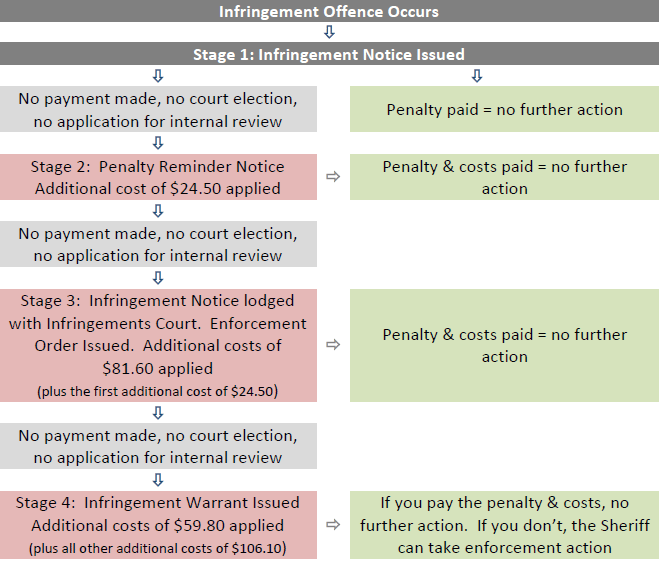
Read a text description of the Infringement flowchart.
If your infringement notice is lodged with the Infringements Court, an infringement warrant may be issued, giving the Sheriff power to enforce that warrant.
The warrant gives the Sheriff power to enforce an unpaid infringement warrant by the:
- seizure and sale of property
- suspension of a driver licence
- suspension of vehicle registration
- non-renewal of vehicle registration
- wheel clamping of a vehicle, or
- arrest of the person.
If an infringement warrant is issued and you pay the outstanding amount, the matter is finalised and no further action is taken against you.
Where can I get further information?
Contact details on who to contact to get further information regarding the infringement notice and your options are detailed on your infringement notice. In most cases, this will be Civic Compliance Victoria (however, you should check your infringement notice to make sure).
Please read the infringement notice carefully and when making any enquiry, you will be required to quote your infringement notice number.
Fees, charges and fines
Find out what fees the department charges for services. Learn how to pay a fine or request a review.
Automatic indexation of fees and penalties
Victorian Government departments and agencies charge:
- fees for services and regulatory purposes, including licensing and registering certain activities
- fines for improper conduct and to discourage unlawful behaviour.
Laws set these fees and fines. Legislation also reviews and updates them.
Lists of indexed fees and penalties
Some fees and fines increase automatically each year. This process is called indexation.
The document below lists the automatically indexed fees and fines that the department manages. These contribute to the Victorian Government’s consolidated revenue.
Resources Victoria – Fees and penalties 2026–27 (Excel, 31.9 KB)
From 1 January 2027, new fees will apply to the mining and extractive industries. Find out more on Engage Victoria.
For minor offences, an enforcement agency may issue an infringement notice (on-the-spot fine). This avoids court action.
The maximum court penalty is the highest amount a court can impose from 1 July 2023. Infringement fines are lower than the maximum court penalty.
The department aims to keep these lists accurate and up to date. It may update or revise these lists when needed.
Important disclaimer
The material provided is intended for use as a general reference only. It is made available on the understanding that while DEECA endeavours to maintain complete, accurate and up-to-date information, users are aware that:
- DEECA does not warrant the accuracy of the information provided and will accept no responsibility for reliance upon it; nor responsibility for any errors or omissions in the material provided
- users should exercise their own care and skill when using the material
- by providing this general information the DEECA is not providing advice
- users should take appropriate professional advice before relying upon the information.
The department provides links to other websites for convenience only. These links do not mean the departments endorses the content on those sites. The department also does not endorse any associated organisation, product or service linked to the websites.
Resources Victoria infringement notices
This page explains what to do if a Resources Victoria authorised officer has issued you an infringement notice.
The most common infringement notice is for not submitting annual reports or returns on time. Officers may also issue notices for:
- breaching a licence or approved work plan
- failing to meet the obligations of a miner’s right
- other resource-related matters.
The Infringements Act 2006 governs all infringement notices.
The department has policies and guidelines on how and when infringement notices are used.
An authorised officer may issue a notice for offences that are infringeable. Infringement notices are one of several enforcement tools authorised officers can use. Officers apply notices using their judgement and within departmental and Attorney-General’s guidelines.
For more information about infringement notices and the infringements system, visit Fines Victoria.
Your options if you receive an infringement notice
If you receive an infringement notice, you can:
- pay the penalty
- elect to have the matter heard by a Court, or
- apply for an internal review.
For most Resources Victoria infringement notices, Fines Victoria manages payments, court requests and internal review applications.
Always check the details on your infringement notice to make sure that Fines Victoria is the right agency to contact.
Licences and services
Visit the Resources Victoria website to:
- Apply for a minerals licence or vary a minerals licence
- Apply for the approval of a work plan for extractive industries
- Find out where to buy a miners right for recreational prospecting
Make a payment
- To pay an invoice from the department, visit Pay bills online.
Other Government fees
To view fees from other departments, visit the Department of Treasury and Finance.
Contact us
For help with a specific fee or fine, including payment options, please contact us.
Page last updated: 19/08/26